
How to Style a Bob Wig: 9 Easy Ways to Make a Bob Wig Look Polished, Natural, and Like You
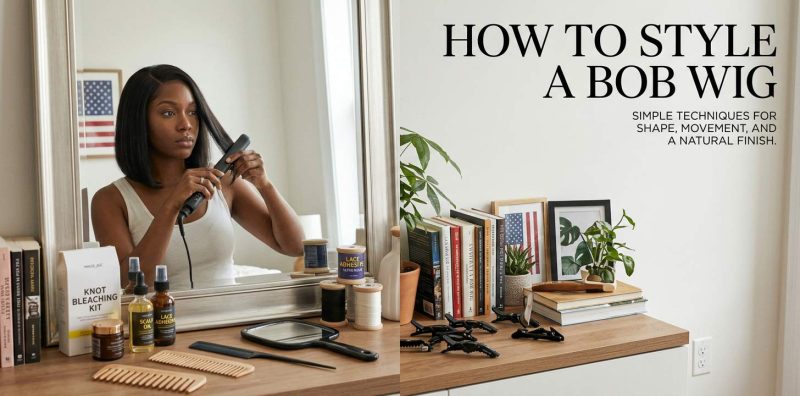
A bob wig has a funny way of exposing your styling mistakes.
With a long wig, you can sometimes tuck a section behind your shoulder and pretend the unevenness was intentional.
A bob doesn’t give you that luxury.
One side is slightly longer? You can see it.
The crown is too bulky? You can see it.
The ends are flipping outward in three different directions? Yes. Everyone can see it.
And yet, that is also what makes a bob so lovely.
When the shape is right, you don’t need much else. A well-styled bob can look polished with jeans and sneakers, beautiful with a simple dress, or completely at home in a boardroom.
The trick is understanding that styling a bob wig isn’t really about doing more to the hair. It’s about controlling shape.
That’s especially true when you’re working with a human hair bob wig. The hair can be curled, straightened, redirected, layered, or softened—but every change affects the overall silhouette.
So instead of giving you a list of random hairstyles, let’s talk about how to actually style a bob wig from the foundation up.
What Makes a Bob Wig Look Good?
Before touching a curling iron, flat iron, or brush, look at the bob from three angles:
Front. Side. Back.
You want the silhouette to make sense from all three.
A good bob generally has:
- A balanced shape around the face
- Controlled volume at the crown
- Ends that follow a deliberate direction
- A believable part
- Hair that doesn’t look excessively dense at the hairline
- Movement that matches the texture of the wig
- A shape that complements, rather than fights, your face
This is why two women can wear the exact same bob wig and style it completely differently.
One may need volume around the crown.
Another may look better with flatter roots and softer movement around the cheekbones.
The goal isn’t to recreate someone else’s bob.
It’s to make your bob make sense on you.
Start With the Wig Construction, Not the Styling Tool
Before styling, identify what you’re working with.
Is it a human hair bob wig or synthetic?
Is it a lace front wig?
Is it glueless?
Is the hair straight, body wave, or naturally curly?
Does it have a defined part?
These questions matter because the styling options change.
Human hair gives you considerably more freedom with heat and restyling, provided you use appropriate temperature control and heat protection.
Synthetic fibers are different. Many are manufactured to hold a particular shape, and applying heat that the fiber isn’t designed to tolerate can permanently damage or melt it.
If you’re deciding between different bob constructions, MsAloe’s bob wig collection is one relevant starting point because the site organizes bob styles separately from other wig constructions.
If your bob is human hair, you can think of it almost like your own hair—but with one important difference.
It doesn’t receive oils directly from your scalp.
That means excessive heat, aggressive brushing, and repeated restyling can eventually make the hair feel dry even when the wig looked beautiful on day one.
How to Prepare a Bob Wig Before Styling
Don’t style a tangled wig.
It sounds obvious, but this is one of those little rules that saves you a surprising amount of frustration.
Place the wig on a mannequin head or stable wig stand.
Then gently detangle.
Start at the ends and work upward.
For a straight bob, a wide-tooth comb or appropriate wig brush can work well.
For a body wave or curly bob, your fingers may be enough.
You want to remove tangles without pulling aggressively on the hair.
Check the Ends Before You Style
The ends tell you a lot.
If they are smooth and reasonably even, you’re ready to style.
If they’re dry, tangled, or bending in completely different directions, fix that first.
Don’t use a flat iron to force damaged ends into submission.
Heat can temporarily make them look smoother while leaving the underlying problem untouched.
How to Style a Straight Bob Wig With a Flat Iron
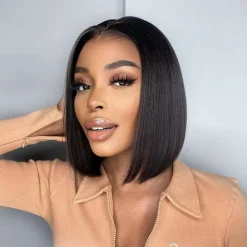
A sleek straight bob is probably the most recognizable version of the style.
And it is deceptively simple.
The mistake people make is thinking:
“Straight means flat.”
It doesn’t.
A beautiful straight bob usually has controlled volume at the roots and a clean, intentional direction through the lengths.
Step 1: Use Heat Protection
If you’re working with human hair, apply a suitable heat protectant according to its instructions.
Allow the product to distribute evenly and avoid saturating the hair.
Step 2: Divide the Hair Into Sections
Work with relatively small sections.
You don’t need microscopic sections.
But if the section is too thick, the heat won’t distribute evenly.
That encourages repeated passes.
Repeated passes are where unnecessary heat damage begins.
Step 3: Use Moderate Heat First
For human hair, start with a moderate temperature rather than immediately turning the flat iron to its highest setting.
The exact temperature depends on the hair’s condition, density, and previous processing.
A healthy virgin human hair wig generally tolerates heat differently from heavily bleached or chemically processed hair.
The principle is simple:
Use the lowest temperature that gives you the result you want.
Step 4: One Slow Pass Is Better Than Several Fast Passes
Don’t repeatedly clamp the same section because the first pass didn’t make it perfectly straight.
Instead, slow down slightly and allow the tool to work.
You are styling hair—not ironing a shirt.
How to Give a Bob Wig a Soft, Curved End
This is one of my favorite ways to make a straight bob feel less severe.
Instead of making the ends completely flat, create a subtle inward curve.
Take a small section.
Place the flat iron slightly above the ends.
Rotate your wrist inward very gently as you move toward the bottom.
Don’t create a dramatic curl.
You want a soft bend.
Think:
“The hair naturally turns here.”
Not:
“I curled the entire bottom.”
This tiny adjustment can change the whole silhouette.
It makes the bob look intentional without looking overly styled.
HD lace wigs
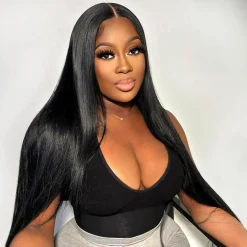
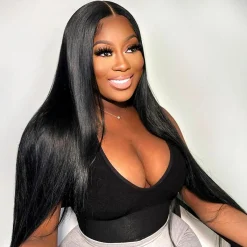
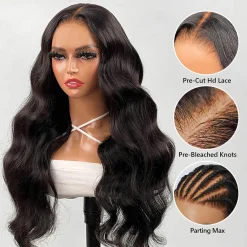
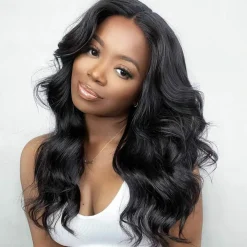
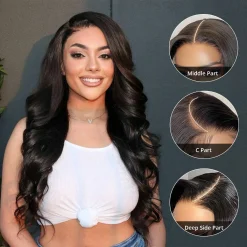
Pre-bleached Knots Straight HD Lace Frontal Wig 180% Density 6×5 Pre-cut Lace Wear & Go Glueless Wig
HD lace wigs
HD lace wigs
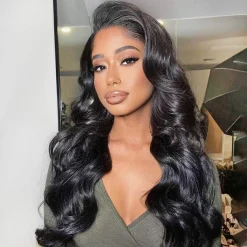
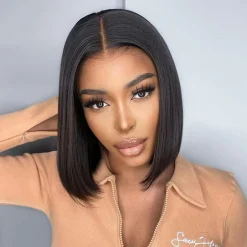
Glueless Straight Short Bob Wigs Brazilian Clear Lace 180% Density Hd Closure Wig Human Hair
HD lace wigs
How to Add Volume to a Bob Wig Without Making It Bulky
This is where many bob wigs go wrong.
Someone wants volume.
They tease the roots.
Then they tease again.
Then they add hairspray.
Five minutes later, the bob looks twice as wide.
The better approach is strategic volume.
Focus on the Crown
Lift small sections around the crown and direct them upward while applying gentle heat.
Then allow them to cool in position.
Cooling matters.
Hair temporarily changes shape with heat, but the shape becomes more stable as it cools.
You don’t need aggressive teasing.
Keep the Sides Controlled
If your face already has fullness around the cheeks, excessive volume at the sides can make the bob feel wider.
Instead, keep the side sections closer to the head and allow more movement at the crown.
If your face is longer, slightly more side volume may help balance the overall shape.
This isn’t a rigid face-shape rule.
It’s more like adjusting the proportions of a room.
You move the visual weight where you want the eye to go.
How to Style a Bob Wig With a Side Part
A side part can completely change the personality of a bob.
A middle part tends to feel symmetrical and structured.
A side part introduces movement.
For a natural-looking side part:
- Decide where the part should sit.
- Use the end of a rat-tail comb to create a clean line.
- Gently redirect the hair.
- Flatten excessive root volume around the part.
- Add subtle lift on the opposite side.
Don’t make the part perfectly straight if your goal is a natural appearance.
Real hairlines aren’t architectural blueprints.
A slightly irregular part often feels more believable.
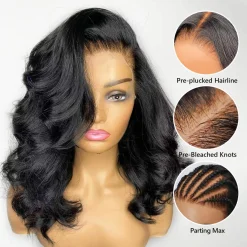
If your bob is a lace front wig, you can also pay attention to how the lace transitions into the forehead area.
The part should make sense with the underlying cap construction.
How to Style a Bob Wig With a Middle Part
A middle-part bob is less forgiving.
Because both sides mirror each other, small differences become obvious.
Start by finding the natural center of the cap.
Create the part.
Then style both sides separately.
The Important Trick: Don’t Chase Perfect Symmetry
This sounds contradictory.
You want balance.
But you don’t necessarily want both sides to be mathematically identical.
Hair naturally has movement.
A tiny difference in how the ends curve can actually make the style feel more realistic.
Think of symmetry as the framework.
Movement provides the personality.
How to Style a Body Wave Bob
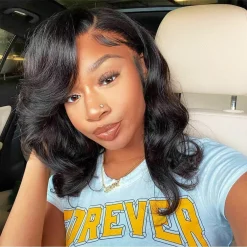
A body wave bob can be gorgeous because the shorter length gives the wave a different visual rhythm.
The biggest mistake is brushing all the texture out.
Instead, preserve the wave pattern.
If you need to refresh it:
- Lightly mist the hair if appropriate for the wig
- Separate sections with your fingers
- Use a large barrel curling tool on human hair when necessary
- Curl sections away from the face for a softer front
- Let each section cool before disturbing it
- Separate curls gently rather than brushing aggressively
A body wave should have movement.
It shouldn’t look like every strand was individually placed.
If you’re interested in how wave patterns behave more broadly, the available MsAloe content includes a discussion of choosing between different natural wave styles.
natural wave styling and texture ideas
How to Create Soft Curls in a Bob Wig
A bob doesn’t need tight curls to look curly.
Actually, large, loose curls can be easier to wear.
For human hair:
- Divide the hair into sections.
- Apply heat protection.
- Use a medium-to-large barrel depending on the desired wave.
- Wrap each section consistently.
- Hold briefly rather than excessively heating the hair.
- Release.
- Allow the curl to cool.
- Repeat around the head.
- Separate gently with your fingers.
Curl Direction Matters Around the Face
For a softer effect, curl the front sections away from the face.
This creates a little opening around the cheekbones.
If every section curls toward the face, the hairstyle can become visually closed.
One small directional change can make the bob feel lighter.
How to Make a Bob Wig Look Less “Wiggy”
A bob’s short length means the hairline matters.
If the front is too dense while the rest of the bob is sleek, the eye notices the difference.
There are four areas I check first.
1. Hairline Density
Too much density right at the front can create a heavy-looking hairline.
2. Parting
A perfectly straight, overly dense part can look artificial.
3. Crown Volume
Too much volume at the top can make a short bob look like a helmet.
4. Ends
If the ends are extremely blunt while the roots have lots of movement, the style can look disconnected.
A natural bob has visual continuity from root to tip.
How to Style a Glueless Bob Wig
A glueless bob wig can be particularly convenient because there isn’t necessarily an adhesive installation step between styling sessions.
But that doesn’t mean the wig automatically looks natural.
Styling still matters.
After placing the wig:
- Adjust the position carefully.
- Check the sideburn area.
- Check the part.
- Smooth the crown.
- Arrange the ends.
- Make sure the bob isn’t sitting too far forward.
- Check the silhouette from the side.
One of the nicest things about a short wig is that you can actually see the entire shape.
Use that to your advantage.
Stand in front of a mirror.
Then turn sideways.
Then look at the back if you can.
The side view often reveals problems that disappear when you’re looking straight ahead.
Synthetic Extensions

Synthetic Extensions
Synthetic Extensions
Synthetic Extensions
Four “Giveaway” Dimensions That Can Make a Bob Wig Look Unnatural
If you’re wondering why your bob looks different from the inspiration photo, don’t immediately blame the wig.
Look at these four dimensions.
Dimension 1: The Silhouette
Is the bob too wide?
Too flat?
Too round?
Too heavy around the jaw?
The silhouette is usually the first thing people notice.
Dimension 2: The Hairline
Does the density gradually transition?
Or does the front look like a thick wall of hair?
The hairline needs to visually connect with the forehead.
Dimension 3: The Part
Does the part look intentional?
Is there too much volume directly beside it?
Does the part match the direction of the rest of the hairstyle?
Dimension 4: The Ends
Are the ends:
- all pointing outward?
- too blunt?
- dry?
- uneven?
- excessively curled?
The ends are especially important on a bob because they’re always visible.
A Realistic Styling Scenario: The Bob That Looked Too Big
Let’s imagine a very common situation.
A woman receives a new bob wig.
She puts it on.
The length looks right.
The color is right.
The hair feels good.
But when she looks in the mirror, she thinks:
“Why does my head look enormous?”
The instinct is often to flatten everything.
That’s not necessarily the answer.
In many cases, the problem is concentrated volume.
The crown may be too high.
The sides may be too full.
The cap may not be positioned correctly.
Or the ends may be flipping outward and increasing the visual width.
Instead of flattening the entire wig, she can:
- Reduce crown volume slightly.
- Smooth the side sections.
- Curve the ends inward.
- Recheck the part.
- Look at the bob from the side.
Suddenly, the same wig can feel much more proportional.
This is why styling is partly a visual diagnosis.
You’re not simply asking, “How can I make this hair prettier?”
You’re asking:
“Where is the visual weight sitting?”
How to Style a Bob Wig for Different Face Shapes
Face-shape advice should be treated as a starting point, not a law.
Your features, haircut preference, glasses, makeup, and personal style all matter.
Still, a few principles are useful.
Rounder Faces
Try keeping some height at the crown while avoiding excessive width directly at the cheeks.
A slightly longer bob can also create a more elongated visual line.
Longer Faces
A little more side movement can help balance the vertical shape.
Soft waves can work particularly well.
Strong Jawline
A bob that ends slightly above or below the strongest point of the jaw can change where attention lands.
If the ends hit directly at the widest part, the jaw can appear more emphasized.
Oval Faces
You have plenty of flexibility.
Center parts, side parts, sleek styles, waves, and different bob lengths can all work depending on the look you’re after.
How to Style a Bob Wig for Work
For an everyday office look, I would keep the styling relatively quiet.
Try:
- Smooth roots
- Soft side or middle part
- Slight inward curve at the ends
- Minimal crown volume
- Controlled flyaways
- Natural movement
You don’t need to make the bob completely flat.
A little movement keeps it from looking overly rigid.
Think polished rather than perfect.
How to Style a Bob Wig for a Date or Dinner
This is where you can have more fun.
Try a side part.
Add loose waves.
Curl the front sections away from your face.
Leave the ends slightly imperfect.
Add a little lift at the crown.
The goal isn’t to create a complicated hairstyle.
It’s to make the bob move.
A short style becomes much more interesting when the hair has different directions and textures instead of sitting like one solid shape.
How to Refresh a Bob Wig the Next Day
You don’t need to completely restyle your bob every morning.
Start with the part.
Then check the crown.
Then check the ends.
Usually, those three areas tell you what needs attention.
For a Straight Bob
Use a brush or comb to remove surface tangles.
Use a small amount of controlled heat only where necessary.
For a Wavy Bob
Use your fingers.
Separate flattened sections.
Refresh only the areas that have lost their shape.
For a Curly Bob
Don’t brush everything out.
Re-form individual curls instead.
The less manipulation you need, the better.
Common Bob Wig Styling Mistakes
Using Too Much Heat
More heat doesn’t automatically create a better finish.
Straightening the Wig Every Day
Repeated heat exposure can gradually reduce the softness and condition of human hair.
Over-Teasing the Crown
This creates bulk rather than natural volume.
Curling Every Section in the Same Direction
Uniform curls can look overly deliberate.
Ignoring the Back
A bob has a 360-degree silhouette.
The back matters.
Making the Ends Too Perfect
A little natural variation can actually make the style feel more believable.
Styling Before the Wig Is Properly Positioned
If the wig is sitting too far forward or backward, you’ll end up styling around the wrong foundation.
A Simple Bob Wig Styling Method You Can Repeat
If you don’t want to think about all of this every morning, use this five-minute framework.
Step 1: Put the wig in the correct position.
Step 2: Check the part.
Step 3: Smooth the crown.
Step 4: Arrange the sides.
Step 5: Fix the ends.
Then step away from the mirror.
Seriously.
Look again after a few minutes.
Sometimes you can see the shape more objectively when you’re not standing three inches from your reflection.
HD lace wigs
Pre-bleached Knots Straight HD Lace Frontal Wig 180% Density 6×5 Pre-cut Lace Wear & Go Glueless Wig
HD lace wigs
HD lace wigs
Glueless Straight Short Bob Wigs Brazilian Clear Lace 180% Density Hd Closure Wig Human Hair
HD lace wigs
How to Keep Your Bob Wig Looking Good After Styling
The styling doesn’t end when you put the heat tools down.
Your maintenance habits determine how much work you’ll need tomorrow.
After wearing the wig:
- Detangle gently.
- Don’t sleep in a wig unless its construction and your routine specifically support that.
- Keep excessive products under control.
- Store it properly.
- Protect the hair from unnecessary friction.
- Avoid repeatedly applying heat to the same areas.
If you use a human hair bob wig frequently, consider rotating between styling methods.
You don’t have to straighten it every time.
Sometimes your hair already looks good.
Leave it alone.
That’s a surprisingly useful hair-care strategy.
Synthetic Extensions
Synthetic Extensions
Synthetic Extensions
Synthetic Extensions
FAQ: How to Style a Bob Wig
Can I use a flat iron on a human hair bob wig?
Yes, human hair wigs can generally be heat styled, but the appropriate temperature depends on the hair’s condition and processing history. Use heat protection and the lowest effective temperature.
How do I make my bob wig look less bulky?
Start by identifying where the bulk is coming from. Reduce excessive crown volume, smooth the sides, check the cap position, and shape the ends. Don’t automatically flatten the entire wig.
How do I style a bob wig with bangs?
Style the bangs separately from the rest of the bob. Use a small round brush or controlled heat to direct them, then allow them to cool in their intended position.
How do I make a bob wig curl?
For a human hair bob, use a suitable curling iron or wand with heat protection. Work in sections, control the heat exposure, and allow curls to cool before separating them.
How do I style a short bob wig?
Focus on silhouette rather than elaborate styling. Smooth the crown, establish the part, control the sides, and shape the ends.
Can I wear a bob wig straight and curly?
If it’s human hair, you generally have much more styling flexibility. A straight bob can be restyled into waves or curls, while a naturally curly or wavy texture can be refreshed rather than completely transformed each time.
How do I make my bob wig look natural?
Pay attention to the hairline, part, crown density, cap position, and ends. Natural-looking styling usually comes from controlling these small details rather than adding more products.
How often should I use heat on a bob wig?
There isn’t one universal schedule. The practical rule is to use heat only when needed and avoid repeatedly restyling the same section. More frequent heat exposure generally means more opportunities for dryness and damage.
The Girlfriend-Style Summary: A Bob Doesn’t Need Much—It Just Needs the Right Shape
If you were sitting beside me with a brand-new bob wig on your lap, I wouldn’t tell you to buy twelve styling products.
I’d probably tell you to put down the brush for a minute.
Look at the wig.
Where is the volume?
Where do the ends fall?
Where does the part naturally want to sit?
Does the front feel too heavy?
Does the back have the same visual weight as the front?
Because styling a bob is really a conversation between the hair and your face.
Sometimes the answer is a little curl.
Sometimes it’s a flatter crown.
Sometimes it’s moving the part half an inch.
Sometimes it’s simply turning the ends inward.
And sometimes—this is my favorite one—you realize the wig doesn’t need another thing done to it.
It just needed you to stop fighting its shape.
A beautiful bob doesn’t have to look complicated.
It can be sleek.
It can be softly waved.
It can have a side part and a little attitude.
It can be slightly imperfect.
The goal isn’t to make every strand behave like it was measured with a ruler.
The goal is to create a shape that feels comfortable, balanced, and believable when you move through the world.
And once you understand that, learning how to style a bob wig becomes much easier.
HD lace wigs
Pre-bleached Knots Straight HD Lace Frontal Wig 180% Density 6×5 Pre-cut Lace Wear & Go Glueless Wig
HD lace wigs
HD lace wigs
Glueless Straight Short Bob Wigs Brazilian Clear Lace 180% Density Hd Closure Wig Human Hair
HD lace wigs
Final Bob Wig Styling Checklist
Before you walk out the door, take ten seconds.
Part: Does it look intentional?
Crown: Is there enough volume without bulk?
Sides: Do they frame your face naturally?
Ends: Are they controlled without looking stiff?
Hairline: Does the density transition naturally?
Back: Does the silhouette still look balanced?
Movement: Does the hair move when you move?
If all seven look good, stop styling.
That’s the secret nobody tells you about a bob.
The last five minutes of styling are often about knowing when to leave it alone.
Synthetic Extensions
Synthetic Extensions
Synthetic Extensions
Synthetic Extensions
